Author: Javier Mondéjar
-

Enrique Monsonís, 2
Calle Enrique Monsonís Domingo, nº 2
![WhatsApp Image 2024-08-11 at 9.11.49 AM (1)]()
![WhatsApp Image 2024-08-11 at 9.11.49 AM]()
![WhatsApp Image 2024-08-11 at 9.11.50 AM (1)]()
![WhatsApp Image 2024-08-11 at 9.11.50 AM (2)]()
![WhatsApp Image 2024-08-11 at 9.11.50 AM (3)]()
![WhatsApp Image 2024-08-11 at 9.11.50 AM (4)]()
![WhatsApp Image 2024-08-11 at 9.11.50 AM (5)]()
![WhatsApp Image 2024-08-11 at 9.11.50 AM (6)]()
![WhatsApp Image 2024-08-11 at 9.11.50 AM (7)]()
![WhatsApp Image 2024-08-11 at 9.11.50 AM (8)]()
![WhatsApp Image 2024-08-11 at 9.11.50 AM (9)]()
![WhatsApp Image 2024-08-11 at 9.11.50 AM (10)]()
![WhatsApp Image 2024-08-11 at 9.11.50 AM]()
Information:
- Newly renovated apartment.
- New furniture
- Wi-fi
- Only one room (studio)
-

Calle Doctor Sapena, 30
![20220408_140040]()
![20220408_140905]()
![20230811_100225]()
![20230811_100246]()
![20230811_100402]()
![20230811_101122]()
![IMG-20230526-WA0044]()
![piso-8-alicantealacant-8200-72040-1366 map a]()
![piso-8-alicantealacant-8200-72040-1366x]()
![piso-8-alicantealacant-8200-72040-1366m]()
Information:
- One room available
- No Smoking
- One month deposit
- Fully equipped kitchen
- Public transportation: tram 1-2-3-4, bus 2
- Pets are not allowed
-

Live Music and Wine Alicante || 13th July
Live music and Wine Tasting
An Evening of Exquisite Wines and Enchanting Live Music in the Vineyards of Various Wineries in Alicante
Would you like to enjoy good live music, every day in a different winery with wine tasting included? This is for you!
FacebookTwitterWhatsAppEmailIn this article:
What does this event consist of?
The event features a wine tasting experience complemented by delicious local food and live music.
Participants will enjoy a selection of carefully chosen wines paired with a variety of traditional tapas, enhancing the flavors and aromas of the wines. Adding to the atmosphere, there will be a live performance by Sara Gee & Rumblin Matt, a Valencian duo known for their captivating American roots music.
This combination of wine, food, and music promises an unforgettable evening in the historic setting of Bodegas Montesanco.
When and where?
This event is one of a series of events held throughout the summer in different wineries in Alicante.
- Date: July 13
- Location: Historic Bodega Montesanco, Camí Albiar Alta, 23 (Teulada), known for its rich history in raisin production and restored to maintain its original essence.
- Time: 7 PM to 10 PM
- Languages: Spanish and English
- Google Maps Location:
How do I get a ticket?
If you want to come to this event you can get your ticket on the official website of the organizers here: https://www.melicatesen.com/producto-13-de-julio24-montesanco-sara-gee-rumblin-matt-2103-431277-87143-en.html
-

Alicante Pink Lake in Torrevieja
Alicante Pink Lake
Everything you need to know to discover this unique place in Alicante: Torrevieja Pink Lake.
Did you know that this place is unique in Spain and that it is also one of the few places in this country where you can see flamingos? All this and much more in this article!
FacebookTwitterWhatsAppEmailIn this article:Ad, Google thinks you’re interested in this
The Pink Lake in Torrevieja Spain
Nestled in the charming town of Torrevieja, Spain, the Pink Lake, known as Laguna Salada de Torrevieja, is a natural marvel that captivates visitors with its vibrant pink hues.
This stunning salt lake owes its unique color to the high concentration of algae and bacteria, creating a picturesque scene that feels almost otherworldly.
Whether you’re looking to snap some incredible photos or simply soak in the beauty, the Pink Lake Torrevieja is a must-see destination that promises to leave a lasting impression.
Where is the pink lake in Alicante
It is located south of Alicante in a town called Torrevieja, about 45 minutes drive from Alicante.
How to get to the pink lagoon of Torrevieja from Alicante
The only way to get to the pink lagoon from Alicante is by car. There is no public transportation that is worthwhile.
By car it is about 45 minutes and you can choose the AP-7 or the N-332 road.
From here we recommend the road that follows the coast, we leave you the exact route on the map.
Pink Lagoon Torrevieja entrance
Located within the Parque Natural de las Lagunas de La Mata y Torrevieja, the entrance is well-marked and easily accessible.
As you make your way in, you’ll find information boards and pathways guiding you towards the best viewpoints.
The entrance fee is free, you don’t have to pay anything. It is simply a lagoon, it has no entrance fee as such.
Ad, Google thinks you’re interested in this
Best time to visit
The best time to visit the Pink Lake in Torrevieja is during the summer months, from June to September, when the vibrant pink hues are at their most intense.
Early mornings and late afternoons offer the best lighting and a more tranquil experience, avoiding the midday heat and crowds.
Weather in Pink Lake Alicante
One good thing about Alicante is that the weather is always nice. There are almost always sunny days and very few cloudy or rainy days.
Here you have the weather in real time
Is it pink all year round?
No, the lake’s pink hue is only clearly visible during the warmer months, when temperatures are higher.
During this time, the bacteria and algae are more active, thus giving off the lake’s color.
Ad, Google thinks you’re interested in this
The pink lake of torrevieja photos
What to expect at the Pink Lake
Expect to be greeted by breathtaking pink waters that change hue with the sunlight, offering perfect photo opportunities.
The area around the lake is serene and peaceful, ideal for a leisurely stroll or a relaxing picnic.
You’ll find informative signs explaining the natural phenomenon and can enjoy the stunning contrast between the blue skies and pink waters.
Some cons about the lake
Despite being considered a natural park and being a place of great beauty, sometimes people are a little disrespectful and dirty the place or break the rules.
You may see people bathing even though it is forbidden or littering the area.
It is not the most common thing but it is something that can happen.Ad, Google thinks you’re interested in this
Is it worth to visit?
Completely. All the people who visit it are very surprised when they visit the lake.
It is a huge pink lagoon, something you don’t see every day.
We recommend spending a nice day at the pink lagoon, enjoy the scenery and visit Torrevieja to complete the visit.
Visit Torrevieja
Torrevieja is a vibrant coastal town that offers a perfect blend of natural beauty and cultural attractions.
In addition to the famous Pink Lagoon Torrevieja, Spain, visitors can enjoy beautiful beaches, lively promenades, and a variety of restaurants and shops.
The town boasts a rich history, charming architecture, and friendly locals. Whether you’re exploring its natural parks, visiting museums, or simply relaxing by the sea.
Things to do in Torrevieja
Powered by GetYourGuideAd, Google thinks you’re interested in this
Where to stay close to the Pink Lake (also called Pink Lagoon Spain)
There are plenty of great accommodation options near the Pink Lake in Torrevieja. From cozy bed and breakfasts to luxurious hotels, you’ll find something to suit your needs and budget. Staying close to the lake allows for easy access to this natural wonder, as well as to the town’s other attractions. Many places offer stunning views and are just a short drive or bike ride from the Pink Lake, making your visit convenient and enjoyable.
Why is the lake pink?
The Pink Lagoon in Torrevieja, Spain,xº owes its stunning color to a combination of natural factors.
The high salt concentration in the water creates an ideal environment for specific algae and bacteria, particularly *Dunaliella salina* and *Halobacterium*.
These microorganisms produce a red pigment called beta-carotene, which, when combined with the salt, gives the lake its characteristic pink hue.
This natural phenomenon not only creates a visual spectacle but also highlights the unique ecological makeup of the area.
Ad, Google thinks you’re interested in this
Can you swim in the Torrevieja Salt Lakes?
Swimming is not allowed.
The lake’s high salt concentration and the presence of delicate microorganisms make it unsuitable for swimming.
Additionally, the lake is part of a protected natural park, and preserving its unique environment is crucial.
But if you want to swim you can go to the other lagoon (Laguna Salada de la Mata), which is in front. Or to the beach, which is very close.
Flamingos at the Pink Lake
One of the delightful sights at the Pink Lake in Torrevieja is the presence of flamingos.
The high salt concentration attracts brine shrimp, a primary food source for the flamingos, making the lake an ideal feeding ground.
Watching these beautiful creatures in their natural habitat is a highlight for many visitors.
Sea and Salt Museum (Museo del Mar y de la Sal)
A visit to the Sea and Salt Museum in Torrevieja offers fascinating insights into the town’s rich maritime and salt production history.
The museum showcases a variety of exhibits, including traditional salt extraction tools, model boats, and historical artifacts.
It provides an educational and engaging experience, highlighting the cultural significance of salt and the sea to the local community. It’s a great way to complement your visit to the Pink Lake.
Are There Health Benefits?
It is believed that the high salt and mineral content has therapeutic properties, benefiting the skin and respiratory problems.
This aspect has increased its appeal, positioning it as a point of interest for those interested in natural health and wellness.
Additionally, the biodiversity in and around the lagoon is remarkable, offering a home to various species of birds and plants adapted to saline environments.
Ad, Google thinks you’re interested in this
History and Culture of the Pink Lake
The geological history of Torrevieja and its lagoon is as rich as its landscape is beautiful. Formed thousands of years ago, the lagoon has witnessed climatic and human changes, each leaving its mark on the environment. Salt extraction, one of the oldest and still active industries in the region, has influenced the local culture, transforming the economy and landscape of Torrevieja.
The cultural influence of the Pink Lake extends beyond its economic impact. It has inspired artists, photographers, and filmmakers, captivated by its beauty and uniqueness. This natural setting has served as a backdrop for numerous artistic works and media projects, promoting conservation and appreciation for nature.
An interesting thing about this lagoon is that it is one of the only pink lakes in spain, almost the unique pink lake in Spain.
FAQ’s About the Alicante pink lake
Where can i park?You can park anywhere near the lagoon and walk to it. No problem at all.
Is it free?Yes.
Is it pink all year round?No, only during the hottest months. From june to september aprox.
Are there toilets or facilities in the area?No.
Are there guided tours?Yes. Visit the Interpretation Center (Visitors’ Center) to arrange for a guided tour of the nature reserve. When planning for a group tour of more than 15 people, it is important to call the office in advance.
CONTACT NUMBER: (+34) 965 721 650
Can I go with pets?Yes, no problem.
Why is the lake pink?The Pink Lake in Torrevieja owes its stunning color to a combination of natural factors. The high salt concentration in the water creates an ideal environment for specific algae and bacteria, particularly *Dunaliella salina* and *Halobacterium*.
Can you swim in the Torrevieja Salt Lakes?No. Is not allowed
Can you see flaymingos in torrevieja pink lake?Yes.
Ad, Google thinks you’re interested in this
-

Santa Barbara Castle Alicante. Everything you need to know.
Santa Barbara Castle Alicante
Santa Barbara Castle. Find out everything you need to know about this 200 year old castle.
The Castle of Santa Bárbara is one of the most important and impressive sites in the city of Alicante. A place that is completely worth visiting, full of history, and also free. Want to know more? This blog is for you.
FacebookTwitterWhatsAppEmail
In this article:
Ad, Google thinks you’re interested in this
About the Castle of Santa Barbara
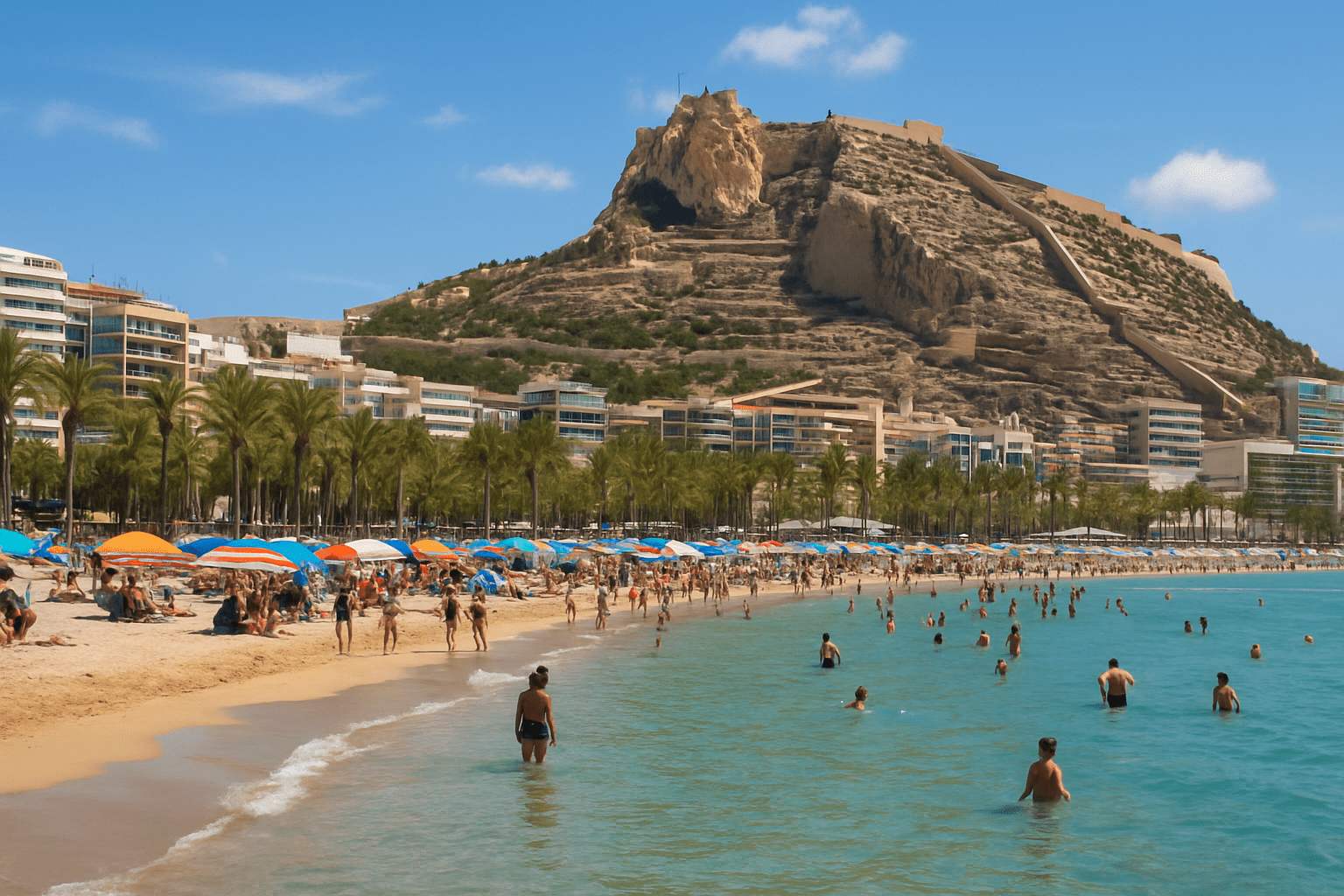
The Castle of Santa Bárbara is a piece of living history in the city of Alicante. It is built on Mount Benacantil and was constructed over 200 years ago. Today, it is one of the most important parts of this city, where all kinds of events and activities take place that you can visit.

How to get to Santa Bárbara Castle Alicante
There are several ways to reach the Castle of Santa Bárbara, but the most popular and scenic options include the walk to Santa Bárbara Castle, which offers breathtaking views of Alicante and the Mediterranean.
The Alicante Castle walk is a favorite among visitors who enjoy a historic and immersive experience, while the castle Alicante walk through Parque de la Ereta provides a shaded, picturesque route.
For those who prefer a quicker ascent, the elevator to Santa Bárbara Castle near Postiguet Beach offers a convenient alternative, making it easy to explore this iconic fortress.
Ad, Google thinks you’re interested in this
How to get to castle santa barbara walking
From the Santa Cruz neighborhood.
You simply need to get to the Santa Cruz neighborhood, one of the most beautiful and oldest neighborhoods in Alicante, with an Arabic layout very similar to typical Andalusian villages. From there, you reach the La Ereta Park, one of the largest and most beautiful parks in Alicante, on Mount Benacantil, just below the castle. And from there, you can continue up to the main road, which provides access to the castle.
From the Tuna Park.
You can visit this park, also at the foot of the castle, gradually make your way up to the main road, and from there, continue up to the castle.
From Virgen del Socorro Street.
This is one of the lesser-known but most beautiful routes, as it starts on Virgen del Socorro Street, one of the most beautiful and oldest neighborhoods in Alicante, the old fishermen’s neighborhood. From there, a route begins through Mount Benacantil among the trees until you reach the main road that leads up to the castle. If you enjoy nature and fancy a walk through a small forest in the middle of the city of Alicante, this route is highly recommended.
By the Elevator
You can also take the elevator. The santa barbara castle lift costs less than 3 euros and the entrance is in front of Postiguet Beach.
You can take a walk along the beach, cross the street, enter the elevator, and go directly up to the castle. This is also a very good option, and you’ll be at the top in no time.
This can be especially appreciated if it’s too hot and you don’t want to walk all the way up.
Price of the elevator of the castle of Santa Barbara Alicante
The alicante castle lift price is:
Free of charge for pensioners or persons over 65 years of age, children under 5 years of age, civil servants in the performance of their duties and Security Forces in the line of duty.
You can get your ticket here (official website): https://castillosantabarbara.alicante.es/CastilloFrontOffice/faces/index;jsessionid=75eb25559d2197728d9a5363b8e0
Alicante Castle Lift Opening Times
Closed Days: The fortress is only closed on December 24, 25, and 31, and January 1 and 6.
Opening Hours:🔹 Low Season (November 15 – February 27): 10:00 AM – 6:00 PM
🔹 Mid Season (February 28 – June 16 & September 5 – November 14): 10:00 AM – 8:00 PM
🔹 High Season (June 17 – September 4): 10:00 AM – 11:00 PM🚠 Schedule of the Santa Barbara Castle Elevator:
⏳ Last ascent: 40 min before closing
⏳ Last descent: 20 min before closing
🚶♂️ Last pedestrian access: 30 min before closingWhere is the lift to alicante castle
The santa barbara castle alicante lift is in Juan Bautista Lafora Avenue (in front of Postiguet Beach). Here you have the alicante castle lift location:
Ad, Google thinks you’re interested in this
By Car
You can also go by car, if you have one, and park in the Santa Bárbara Castle parking lot.
There is usually space, but it can be difficult to find parking during the high season and summer.
We suggest that this is the least recommended option, as parking can be problematic and you won’t enjoy the ascent as much as you would if you went on foot.
By Bus
There is also the option to take a bus to the alicante castle. There is a specific line for that, the csb bus alicante. Here you can check all the info: https://alicante.vectalia.es/linea/lanzadera-castillo-santa-barbara/#linea=CSB
Santa Bárbara Castle Timetable Santa Barbara Castle Alicante Spain Timetable
Period Days Opening Hours From November 15 to February 27 Monday to Sunday 10:00 a.m. to 6:00 p.m. From February 28 to June 16 Monday to Sunday 10:00 a.m. to 8:00 p.m. From June 17 to September 4 Monday to Sunday 10:00 a.m. to 11:00 p.m. From September 5 to November 14 Monday to Sunday 10:00 a.m. to 8:00 p.m. Events in Santa Bárbara Castle
Powered by GetYourGuideAd, Google thinks you’re interested in this
Things that you must see in Alicante Santa Barbara Castle
Arm Square (Patio de Armas)
The largest square in the entire castle in Alicante, it is impossible not to pass through it, as it is right at the entrance. During the summer there are sometimes concerts here.Map here
The highest point of the city of Alicante
The highest place in Alicante and with the best panoramic views of the whole city. The best views from the castle in alicante spain.
Map here
The best place overlooking the beach with tables and chairs in Alicante.
One of the most pleasant places in this city. With the best views of the Postiguet Beach and with tables and chairs in the shade to enjoy the place.
Map here
Ad, Google thinks you’re interested in this
Castle Aanta Barbara Alicante History
Santa Bárbara Castle, located in Alicante, Spain, has a history stretching back to the Bronze Age. The structure seen today began in the 9th century under Muslim rule. It was named after Saint Barbara when Prince Alfonso of Castile captured it in 1248. Significant expansions were made in the 14th and 16th centuries under Spanish kings. Used for military purposes until the 20th century, it opened to the public in 1963.
Today, Santa Bárbara Castle is a prominent tourist attraction, hosting cultural events and offering panoramic views of Alicante. The castle’s rich history and well-preserved architecture make it a must-visit site for those exploring the region.
-

Río de Bolbaite. Todo lo que necesitas saber
Río de Bolbaite
Todo lo que necesitas saber sobre el Río de Bolbaite
Todos los detalles de esta localidad. Desde cómo llegar hasta qué comer. Rutas por el río, normativas para el baño…
home » Archivo de Javier Mondéjar » Page 3
FacebookTwitterWhatsAppEmail
En este artículo
Cómo llegar al Río de Bolbaite
Te contamos cómo llegar a este lugar en coche. A penas hay transporte público que llegue a Bolbaite.
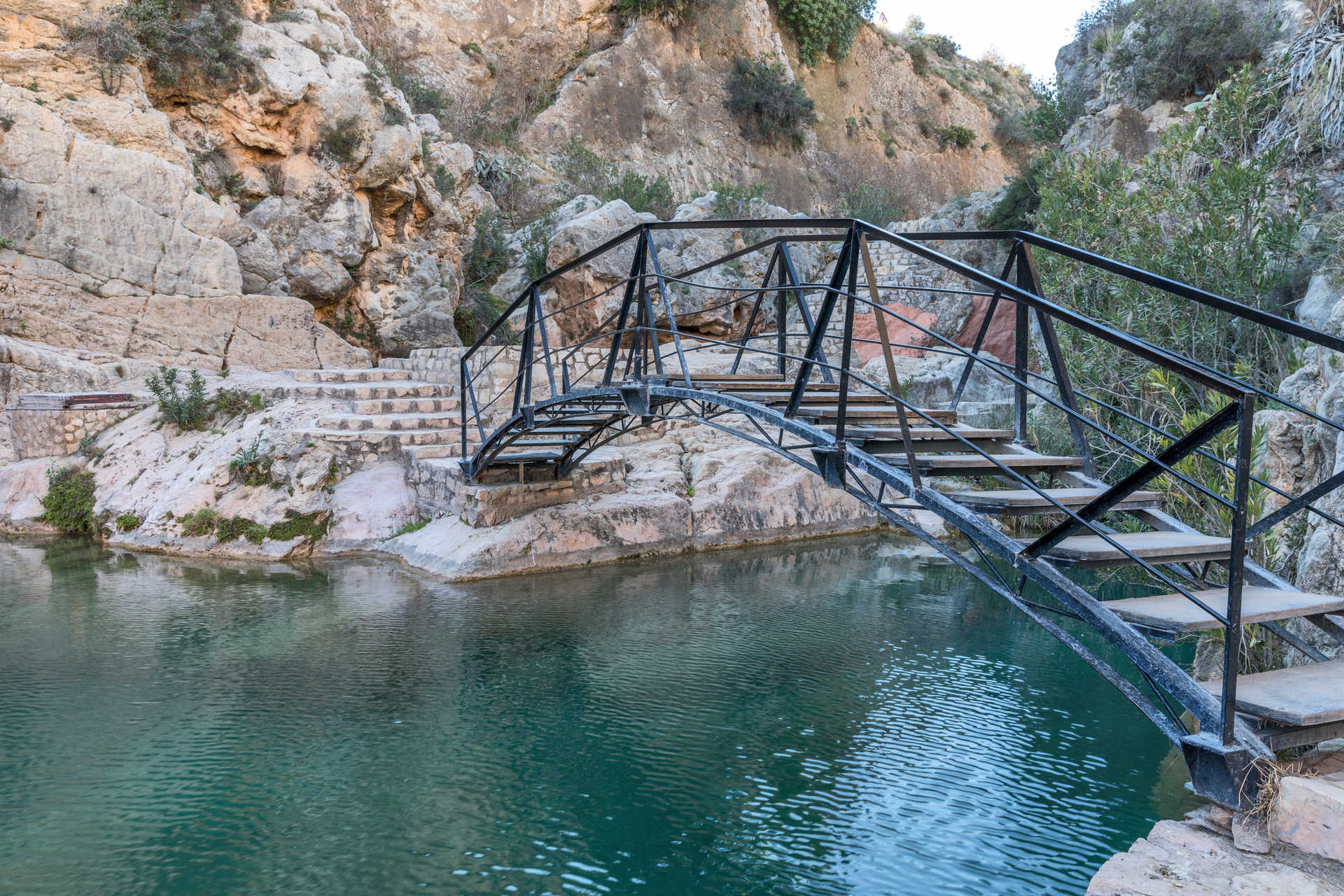
Desde Alicante (1h 30 min aprox)
Para llegar desde Alicante hay dos opciones principales, o bien coger la A-31 o bien la A-7.
- Si vas por la A-31 tendrás que coger esta carretera saliendo de Alicante por Óscar Esplá. Una vez estés en ella tendrás que conducir una hora aproximadamente hasta la salida 42 para coger la CV-585 y 580 que te llevarán directas hasta Bolbaite.
- Para ir desde la A-7 tendrás que salir de Alicante por la Avenida de Jijona. Una vez en la A-7 tendrás que conducir aproximadamente una hora hasta tomar la A-35. Una vez en la A-35 sal por la salida 42 para coger la CV-585 y 580 que llevan directas a Bolbaite.
Desde Valencia (1h aprox)
Sal por Ausias March hacia la A-7. Una vez en ella conduce una media hora hasta salir hacia la CV-590. Una vez en esta simplemente síguela hasta dar con la CV-580, la cual te llevará directamente a Bolbaite.
Entradas para el río de Bolbaite
Desde Junio y hasta Septiembre se tiene que pagar una tasa para acceder a la zona recreativa de Bolbaite. Se puede reservar la entrada al río de Bolbaite online. Estos son los precios:
Precios 2023:
- Niños/as menores de 5 años: Gratis
- Adultos y mayores de 5 años: 3€
- Mayores de 65 años: 2€
El aforo es de 400 personas. 250 con entrada online y 150 con entrada en taquilla. Puedes comprar las entradas online aquí.
Área recreativa del Río de Bolbaite
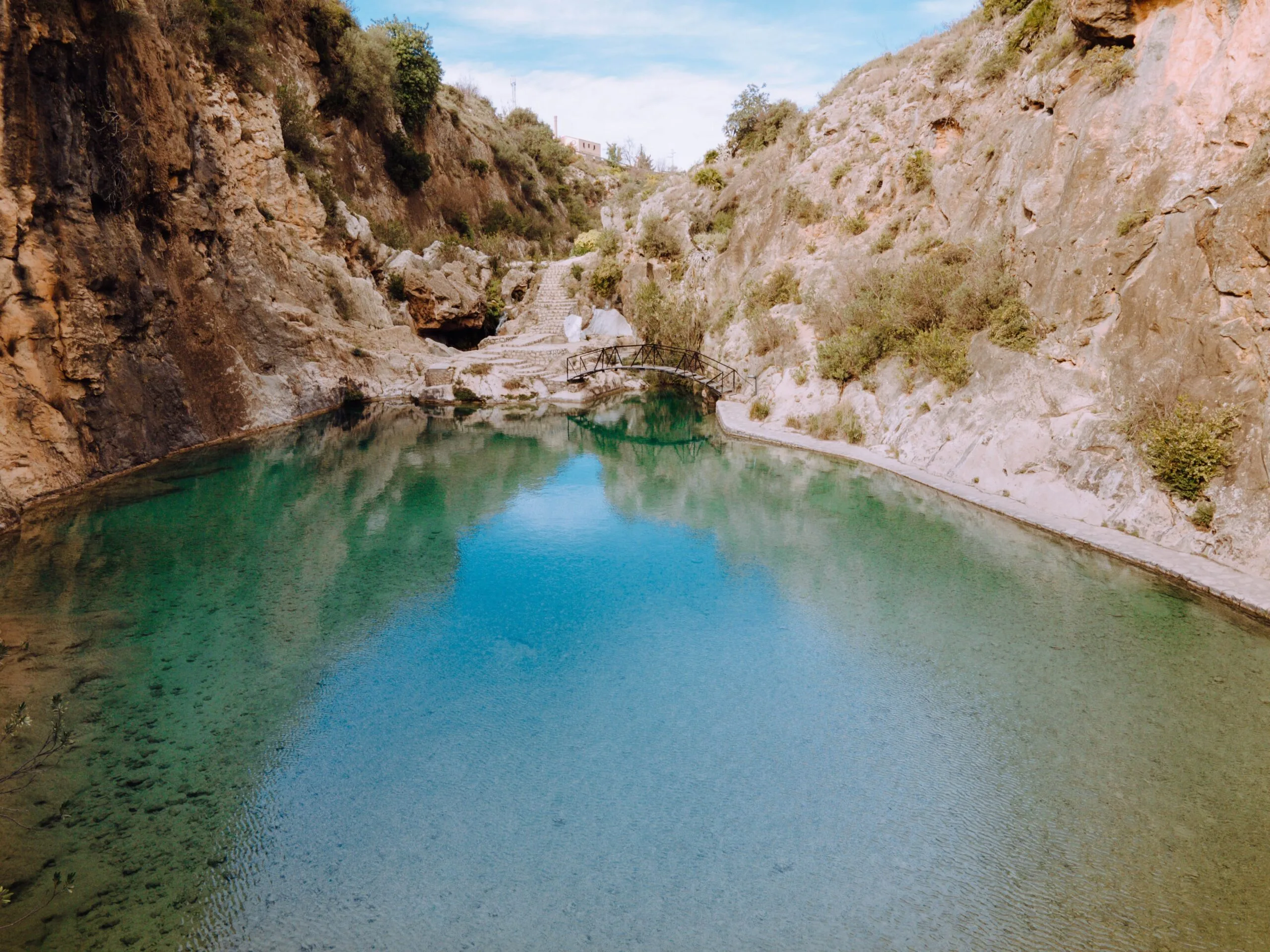
Esta zona recreativa es perfecta para comer algo o simplemente para pasar el rato con amigos o con la familia cerca del río Sellent. Se trata de una zona alargada que sigue la forma del río y dispone de varias mesas, aseos y hasta está equipada con duchas. También dispone de fuentes y parking para bicis.
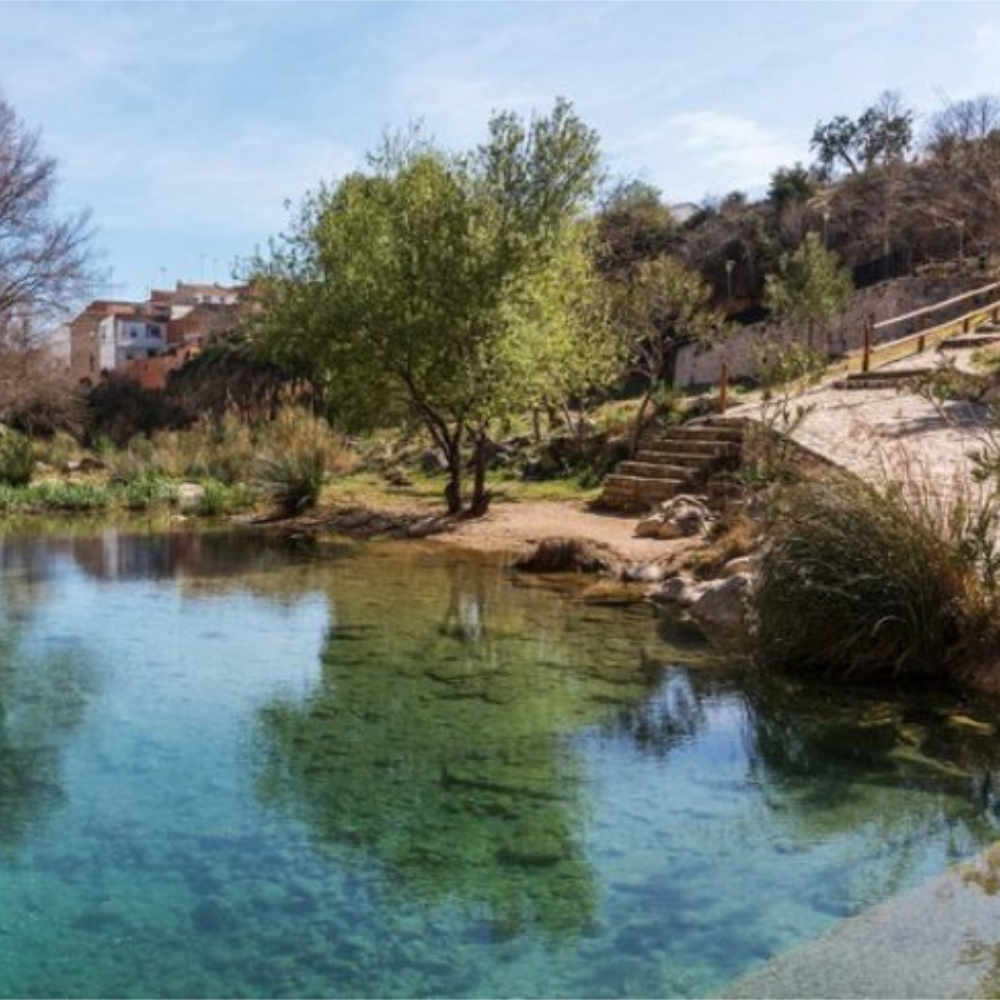
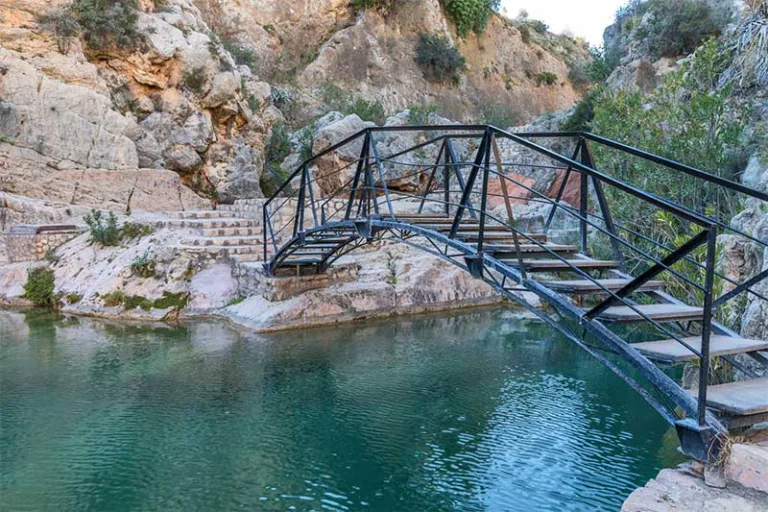
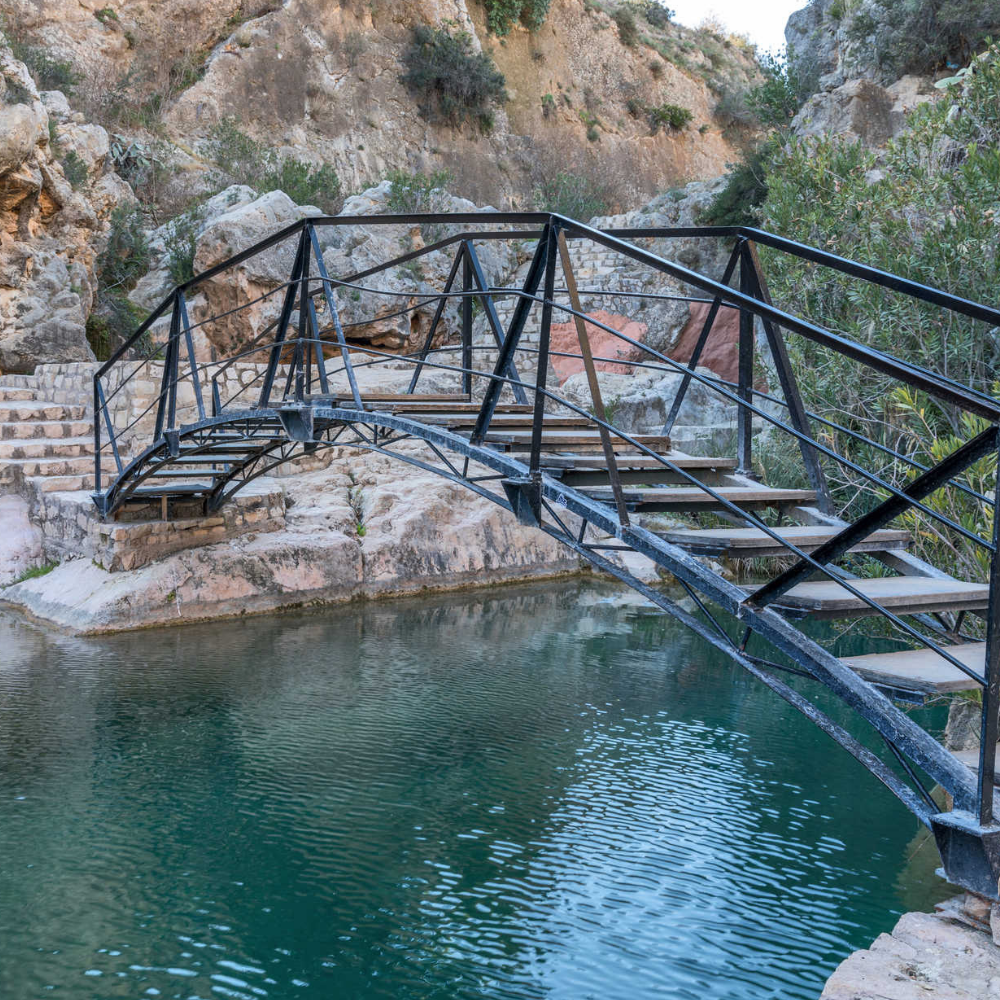
Piscinas Naturales de Bolbaite
Imagina esto: un pueblo con un ayuntamiento a menos de 10 minutos de la orilla de un río. ¿increíble no? Eso es exactamente lo que pasa en Bolbaite con el río Sellent. Y han tenido una idea buenísima, han construido una zona enorme dentro del río para poder darse un buen baño. Esta es la piscina natural del Río de Bolbaite. Sin duda una de las mejores opciones para luchar contra el sofocante calor del verano.
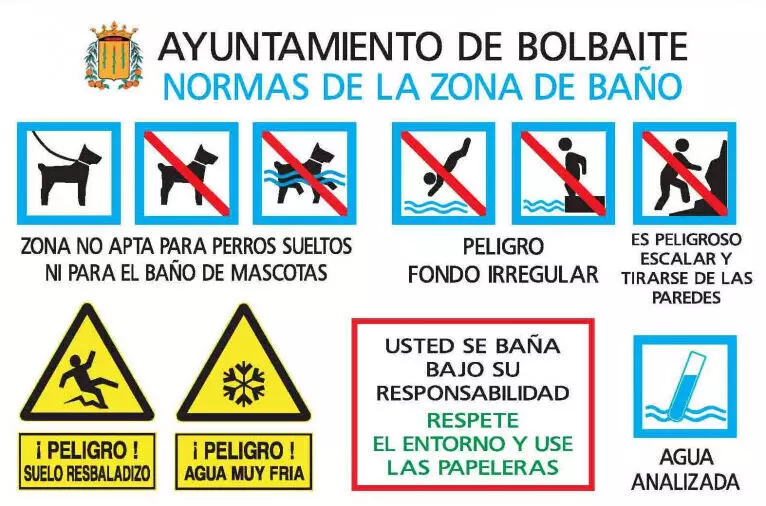
Normativa de las piscinas naturales de Bolbaite
La única restricción que existe es para las mascotas. Es una zona en la que no se permite el baño a mascotas ni el paseo libre de las mismas.
Lugares de interés en Bolbaite
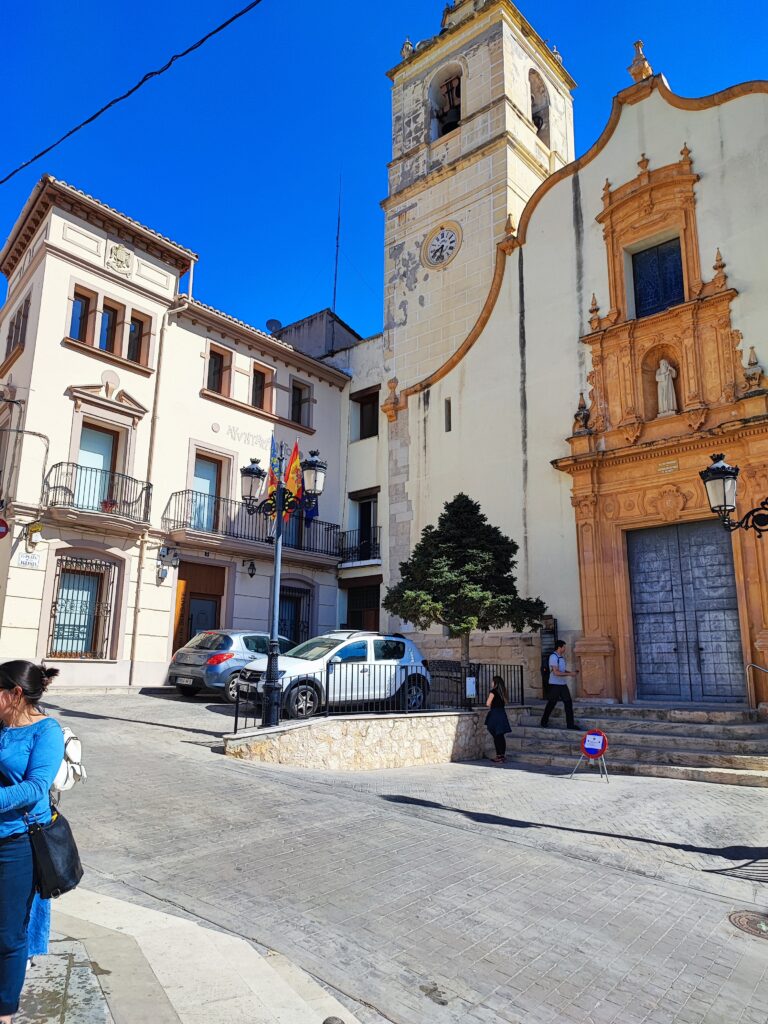
Plaza del ayuntamiento de Bolbaite
Se trata de el lugar central del pueblo y el lugar donde ocurre todo. Una zona de paso obligado para todo el que quiera visitar el pueblo y conocer mejor la cultura local.
Castillo de Bolbaite
Puedes visitar las ruinas del castillo de Bolbaite, situado en lo alto del cerro de Bolbaite. Algo muy interesante es que este castillo se construyó sobre una antigua fortaleza árabe y se empleó durante muchos años como fortaleza y hogar de los señores de la zona.
imagen de www.bolbaite.es Ermita de Santa Bárbara de Bolbaite
Una ermita construida en el siglo XVII en lo alto del monte Bolantín, a unos 350m de altura. Desde ahí se tienen las mejores vistas de Bolbaite y además en la parte más alta se encuentra un merendero y una zona acondicionada para hacer barbacoas. Sin duda una de las atracciones más interesantes de esta localidad.
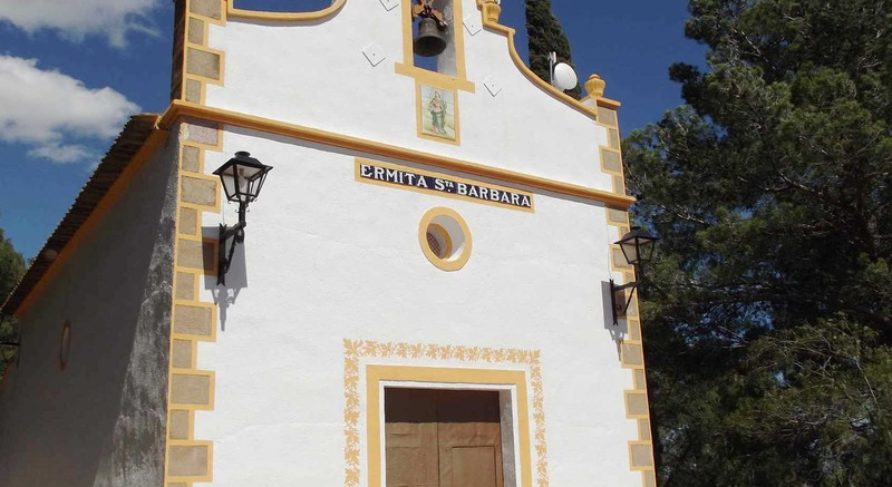
imagen de www.lacanalturismo.com Ubicación de las piscinas naturales de Bolbaite
Llegar a ellas es muy sencillo. Simplemente tendrás que caminar por la Calle del Río desde la plaza del ayuntamiento durante un minuto o menos. Están realmente cerca. Es imposible no verlas. Si vas en coche simplemente aparca en el aparcamiento de las piscinas naturales y baja andando. Es realmente sencillo.
Donde comer en Bolbaite
Afortunadamente este lugar cuenta con diferentes sitios donde comer y disfrutar de la gastronomía local. (Imágenes de www.tripadvisor.com)
Restaurante la Ermita
Situado junto a la ermita de Santa Bárbara, uno de los mejores lugares para probar la comida local. Desde aquí recomendamos pedir un buen arroz. ¡No te arrepentirás!
La gasolinera
Un lugar de comida tradicional con un muy buen trato y buena calidad en sus platos.
Bar el Puente
Uno de los sitios más clásicos de Bolbaite. Con muy buena cocina y ubicado justo al lado del río, sus vistas son espectaculares.
La cuina d’Oti i Alex
Un restaurante con cocina mediterránea en el que poder disfrutar de un buen plato de carne, de pasta o de una buena pizza.
Dónde pasar la noche en Bolbaite. Turismo y casas rurales
Bolbaite es un lugar ideal si quieres pasar una temporada en un ambiente natural y tranquilo. Aquí te enseñamos algunas de las mejores opciones para alquilar una casa en Bolbaite.
Los cipreses
Una casa rural espectacular en la que podrás pasar una experiencia increíble. Esta completamente equipada con todo lo que necesitas y mucho más; aire acondicionado, TV, wi-fi, calefacción…
Dispone de 3 habitaciones dobles, 2 baños, terraza y patio. Si quieres saber más haz click aquí
(Imágenes de https://www.escapadarural.com/casa-rural/valencia/los-cipreses)
Rutas en el río de Bolbaite
Existen muchas rutas que siguen al río Sellent y pasan por todo su recorrido. Nosotros desde aquí os recomendamos la ruta que va desde el río de Bolbaite hasta el Salto de Chella. Sin duda esta es una de las más bonitas de hacer y también de las más sencillas. Puedes acceder a toda la información aquí.
Preguntas Frecuentes (FAQ’s)
Se trata de el río Sellent. Nace al sur del canal de Navarres y desemboca en el río Júcar para finalmente terminar su recorrido en el Mediterráneo
Durante los meses de verano sí. La entrada es de 3€ para adultos. Los niños de menos de 5 años no pagan. Puede pagarse online aquí o directamente en la entrada.
Hay un parking justo a la entrada. Ahí puedes dejar el coche sin problemas.
Sí se puede pero no está permitido el baño para mascotas ni tampoco el paseo libre.
Puedes hacerlo online aquí o directamente en la entrada
Sí. No hay problema. De hecho hay una zona de picnic en la que puedas comer.
Sí. Está lleno de zonas así. No hay problema.

-

+50 Spanish and Latin Songs
Discover new music in Spanish
Here is a list of more than 50 Latin and Spanish songs. There is nothing you are going to hear on the radio or in the clubs. From flamenco to urban music. Hope you like it!
FacebookTwitterWhatsAppEmailhome » Archivo de Javier Mondéjar » Page 3
In this article:
Music groups from Alicante
We start the article with a selection of local groups from Alicante.
Caracoles – Los Ibiza
Oliendo a Perderme – Los Ibiza
La de los Gatos – Siensajah
Solecito – Siensajah
No es pa mi – La Coctelera del Indio
Cumbia Ritual – La Coctelera del Indio
Don Latino – Jade Elam
Balconing – Viscopaf
La mejor Solución – Viscopaf
Live session at Recreo – Viscopaf
No Vale la Pena – Los Ibiza
Puedes Calmarme – Brainstorming
Tropical Sadness – Butter Clouds
Broken Plates – Aardvark Asteroid
Latin Music
Salsa, bachata, cumbia and much more!
Viene de Mi – La Yegros
Matador – Los Fabulosos Cadillacs
Elsa – Bareto
Rosa – Magín Díaz
Cumbia Sobre el Mar – Quantic
Chambacú – Quantic
Juana Peña – Willie Colón y Héctor Lavoe
Colocao – Niki Nicole (Tiny Desk)
Llorarás – Oscar de León
Toro Mata – Celia Cruz
Fuego en el 23 – Sonora Ponceña
La Cartera – Larry Harlow
Triste y Vacía – Hector Lavoe
Mafiosa – Nathy Peluso
Valió la Pena – Mark Anthony
Periódico de Ayer – Hector Lavoe
Flamenco and Spanish singer-songwriters
From the most famous to the little known but very good and classic flamenco.
Frío Sin Ti – Navajita Plateá
La Vida Está de Lujo – Navajita Plateá
19 Días y 500 Noches – Joaquín Sabina
Pureza – Rafael Riqueni
Noches de Bohemia – Navajita Plateá
Una Noche de Amor Desesperada – Triana
Tu Frialdad – Triana
Como el Agua – Paco de Lucía y Camarón de la Isla
Candela – Raimundo Amador
Hoy no Estoy pa Nadie – Raimundo Amador
Veneno que Bueno – Raimundo Amador
Vente Vente – Martires del Compás
Romero Verde – Lole y Manuel
Ahora que – Joaquín Sabina
Echo de Menos – Kiko Veneno
Chulailo la leilo – Martires del Compás
Corazón Partio – Alejandro Sanz
Me Maten – C Tangana
Tiny Desk Concert – C Tangana
Ciudad de las Ideas – Vicente Amigo
Chanelando – Diego el Cigala
-

Cabo de las Huertas Lighthouse
Useful information if you want to visit the lighthouse of Cabo de las Huertas.
Did you know that this place is a very special place, full of nature, with the ruins of a Spanish war bunker and less than 20 minutes from downtown? I tell you all about it in this article!
FacebookTwitterWhatsAppEmail
In this article:
Cabo de las Huertas Lighthouse – Alicante Visitor Rating
★★★★★☆ 4.5/5 (500 reviews)Location
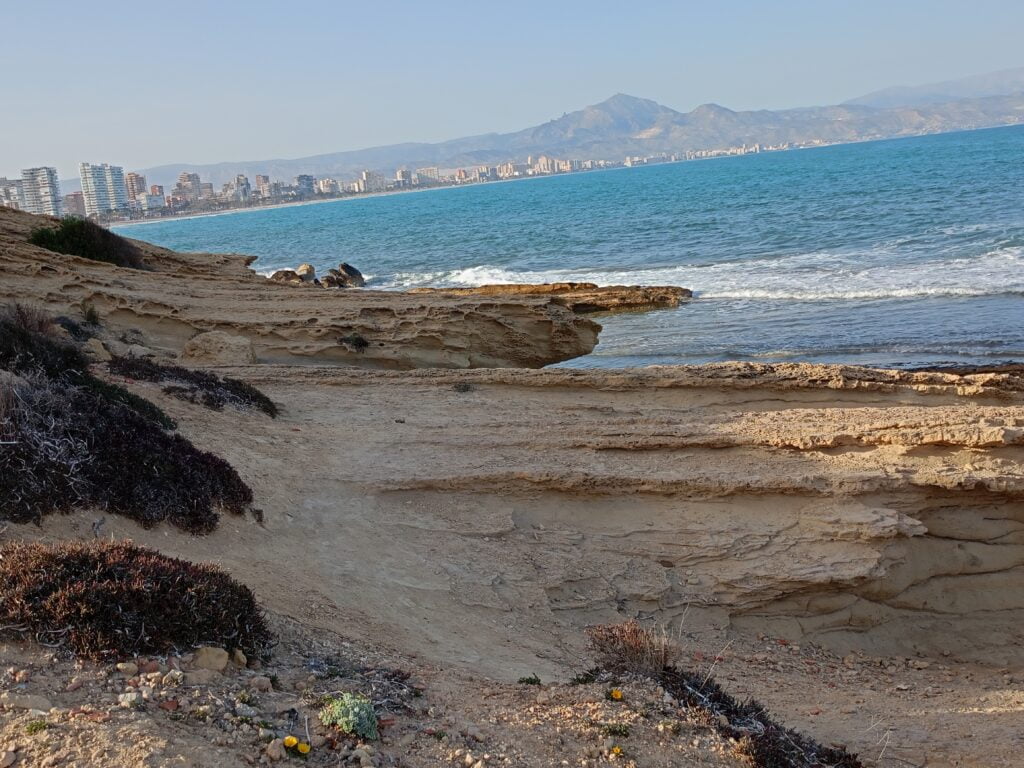
The Cabo de las Huertas Lighthouse is located in Alicante, in the charming Valencian Community, Spain.
It is located in Cabo de las Huertas, north of Alicante and south of San Juan. Between the beaches of San Juan and Albufereta.
This coastal gem is nestled in an area renowned for its beautiful coves and cliffs, offering a picturesque retreat that combines the serenity of the Mediterranean Sea with the wild and unspoiled nature.
Access
Getting to the lighthouse is very easy and offers various options: you can go by car, bicycle, or even on foot if you’re feeling adventurous.
There is parking available nearby, and from the center of Alicante, it’s only about a 20-minute drive.
You can also take the L4 tram line and walk from the nearest stop, Avenida de las Naciones.
You can also go by bus with lines 22 and 28.

Hours and Restrictions
It is not possible to enter the lighthouse or its enclosure, the passage is prohibited for security reasons. But you can be in the surroundings and enjoy nature.
Views and Landscapes
From the lighthouse, you can enjoy breathtaking panoramic views of the Mediterranean Sea and the Alicante coastline.
This place is ideal for photography enthusiasts and those who simply want to relax while listening to the soothing sound of the waves as the sun sets on the horizon.
Water Activities
The coves around the cape are perfect for swimming, snorkeling, and diving.
The crystal-clear waters and rocky formations create a wonderful environment for exploring marine life.

Conservation and Environmental Respect
It is essential to be respectful of the natural environment. Make sure not to leave any trash behind and respect the local flora and fauna. Always follow the instructions to preserve the beauty and health of the place so that future generations can also enjoy it.
Photography and Drones
The lighthouse and its surroundings are extremely photogenic.
If you plan to use drones, make sure to check local regulations regarding their use to avoid any violations.
This way, you can capture spectacular images while respecting the laws and tranquility of the area.
-

Bonfires 2024. Hogueras de San Juan 2024.
Bonfires of san juan 2025
All you need to know about this festival in Alicante
Learn everything you need to know about this festival. What it consists of, what to do, where to try the typical gastronomy, tips, advice and much more!
FacebookTwitterWhatsAppEmail
In this blog:
👉 Note: In Valencian / Catalan the bonfires are called “fogueres“. It is a word that you will see written on the street many times. The word “foc” means fire.
Hogueras de San Juan 2025: All You Need to Know
The bonfires of San Juan are the biggest festival in Alicante. They are prepared throughout the year and are celebrated for a couple of weeks.
Whether you are a first-time visitor or a returning enthusiast, this guide will walk you through everything you need to know about the Hogueras de San Juan 2025 Festival.
Bonfires of San Juan. Official video.
What Are the Bonfires of San Juan?
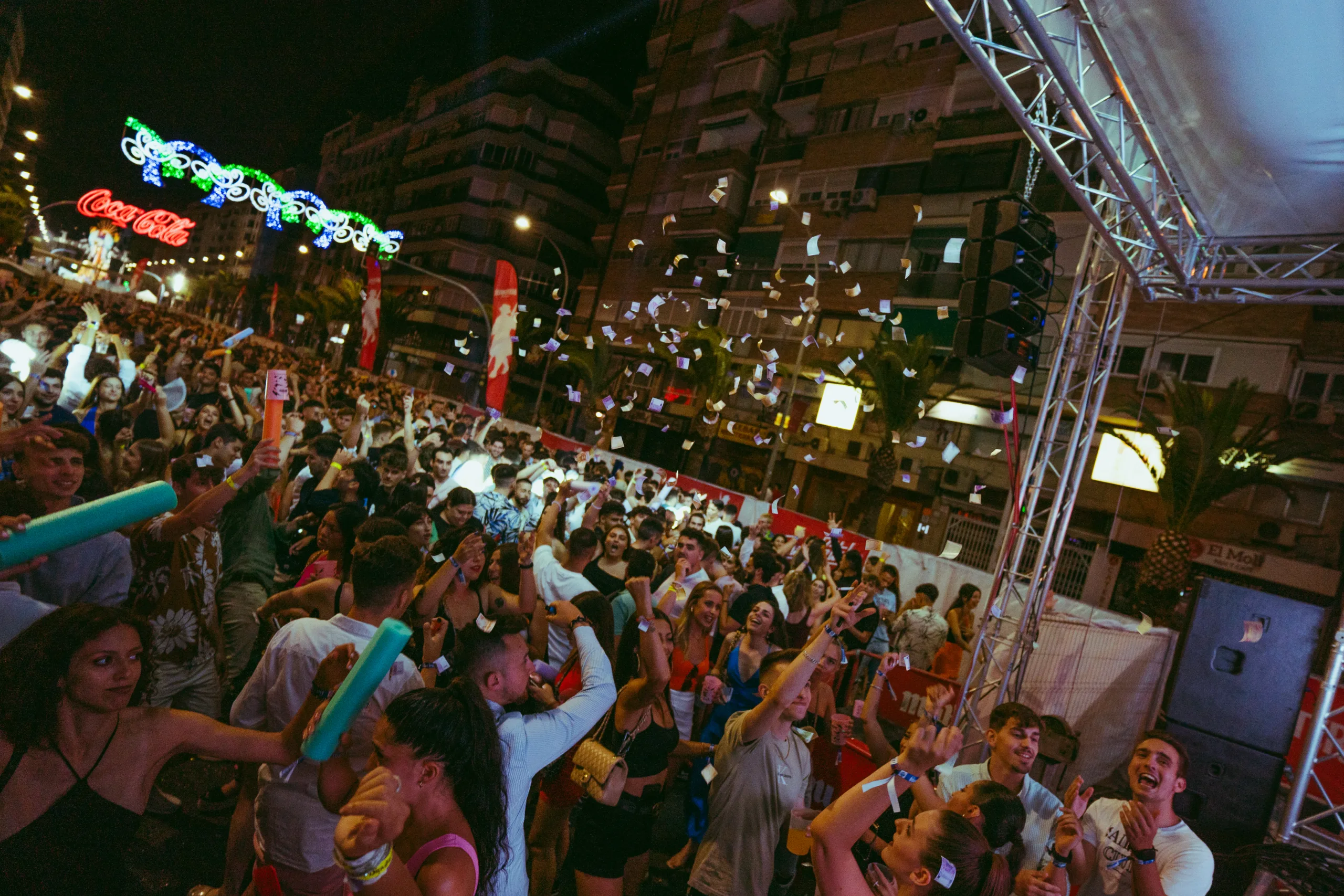
The Bonfires of San Juan, or “Hogueras de San Juan,” (San Juan Festival Alicante 2025) is an annual festival held in Alicante to celebrate the arrival of summer.
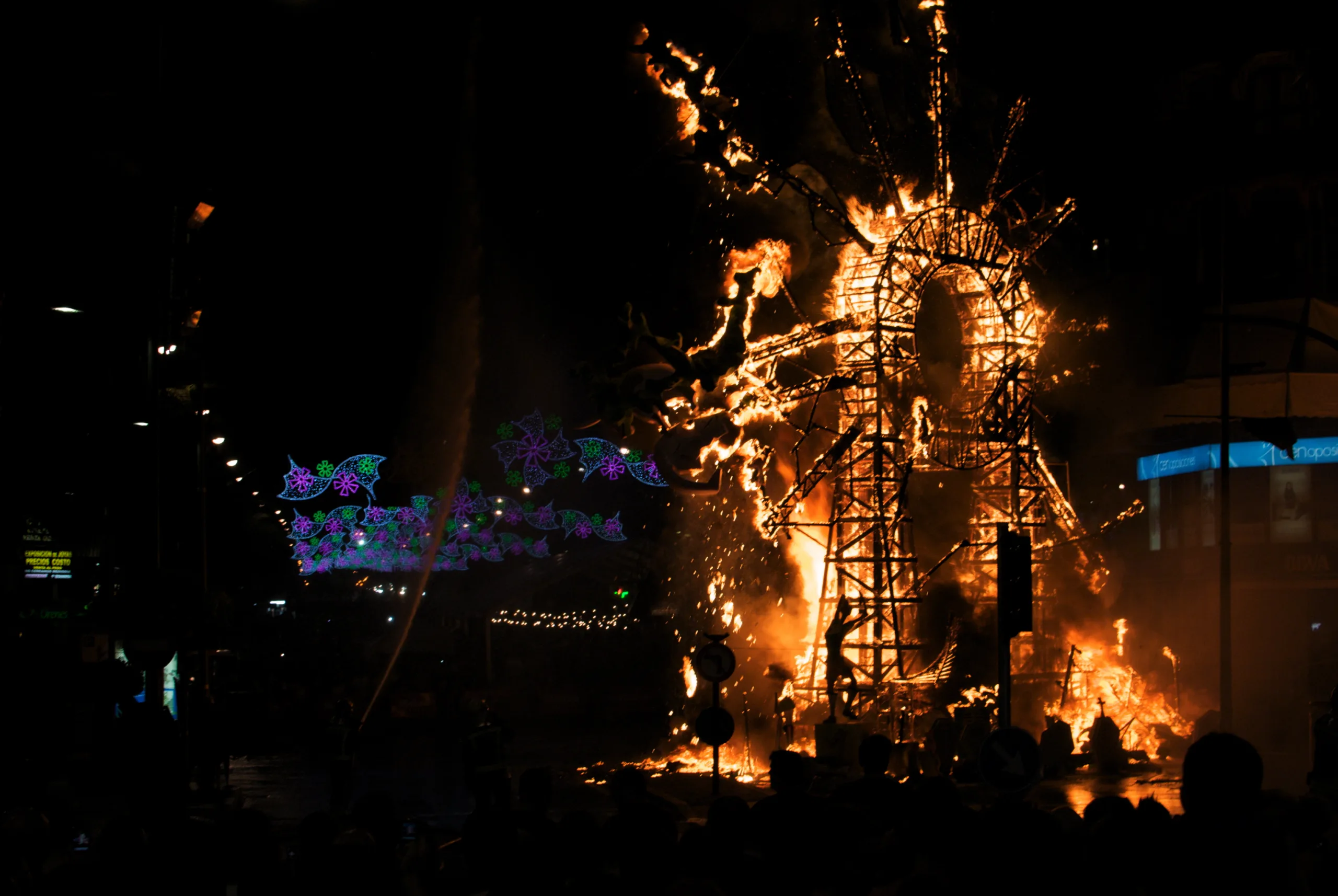
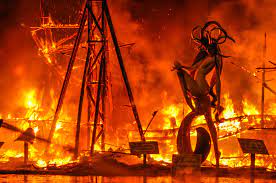
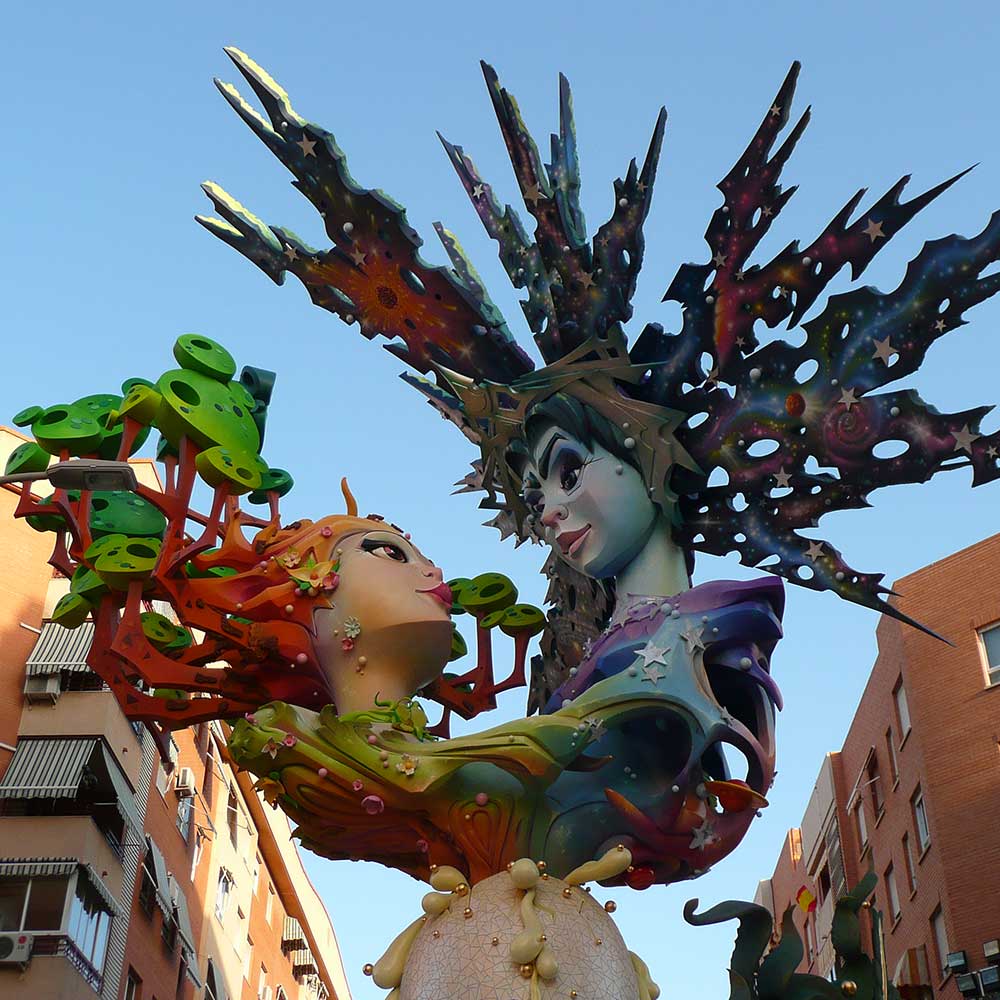
The festivities revolve around the creation and burning of large, intricate sculptures made of wood and papier-mâché, known as “hogueras” or bonfires. These stunning works of art often depict satirical scenes, celebrities, political figures, and local themes, showcasing the creativity and craftsmanship of local artists.
The festival culminates in the burning of these hogueras on the night of June 24, in a spectacular event known as “La Cremà.“

Alicante Fireworks 2025 Schedule for Bonfires Alicante.
April:
- Social gatherings of the candidates for Bellea del Foc (4th, 5th, 6th).
- Social gatherings of the children’s candidates (21st and 22nd).
- Gala of the children’s candidates on Friday, 25th at the Bullring.
- Gala of the adult candidates on Saturday, 26th at the Bullring.
May:
- May 2nd: Election of the Bellea del Foc Infantil (Children’s Bellea del Foc).
- May 3rd: Election of the Bellea del Foc.
- Andrés Llorens Band Festival on Friday, 9th.
- Nighttime Mascletà on Saturday, 10th.
- Theatre competition on Sunday, 11th.
- Proclamation of the children’s Belleas on Friday, 16th.
- Proclamation of the adult Belleas on Saturday, 17th.
- Proclamation party on Saturday, 17th.
- Fogueres Fest on Saturday, 24th.
- Mascletà in sector 5 on Sunday, 25th. 🧨
- Opening of the Ninot exhibition at the Lonja del Pescado on Friday, 23rd.
- Award ceremony for the Foguerers on Saturday, 31st.
June:
- Rice contest in Lo Morant Park on Sunday, 1st.
- Música per una Festa event, homage to the deceased Foguerer and Barraquer, parade of the proclamation, the proclamation, and the subsequent party on Friday, 6th.
- Ninot parade on Saturday, 7th.
- Mascletà on Sunday, 8th. 🧨
- Entrance of the bands on Saturday, 14th.
- Mascletà at the Gran Vía roundabout on Sunday, 15th 🧨
- Closing of the Ninot exhibition and award ceremony on Sunday, 15th.
- Arrival of the fire at El Corte Inglés on Monday, 16th.
- Offering of flowers on Saturday, 21st and Sunday, 22nd.
- Award ceremony on Sunday, 22nd.
- International folkloric parade on Monday, 23rd.
- Cremà and the Palm Tree on Tuesday, 24th 🔥🚒
- Multicolor parade on Sunday, 29th.
The Cremá
The Cremà day is the ultimate highlight of the Hogueras de San Juan. Is the same day of san juan, june 24th, the last day of this alicante fire festival.
This day is the day that all bonfires are burned. The first one is always the one at the town hall and then they are burned in order. From the lowest parts of the city to the highest.

It starts at 12:00 in the night and just at that moment a huge firework called “la palmera” is thrown from the castle. That is the signal that the first bonfire is burning.
Something very special about this day is that firefighters not only use water to extinguish the flames, but they also cool people down. So if you go to see it make sure you are in your bathing suit.
👉Note: if you are going to see the cremá and you want the firemen to get you wet, it is highly recommended that you carry a backpack and keep your phone inside the backpack in a plastic bag.
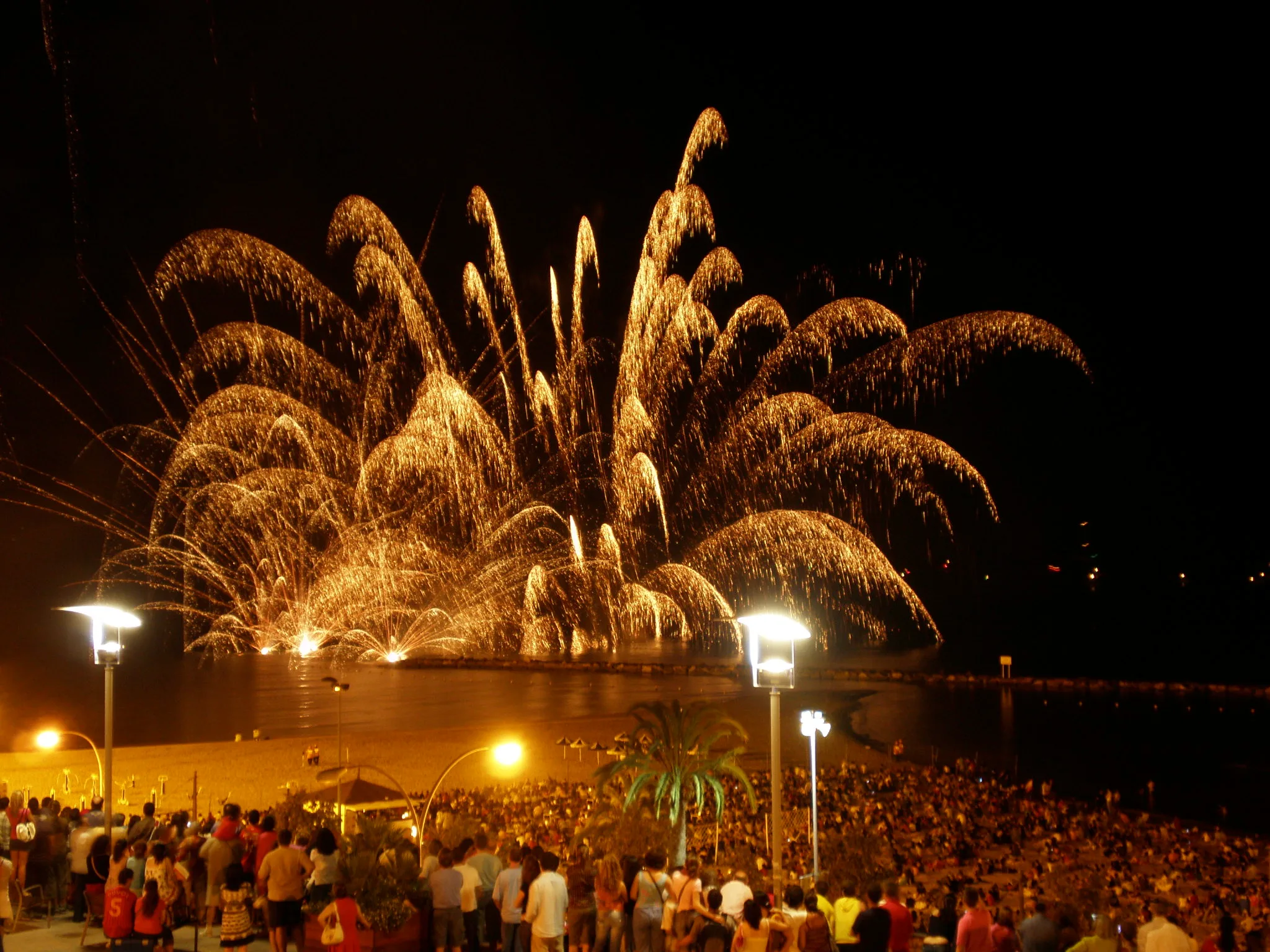
Fireworks on the Alicante beach after bonfires 2025
After the bonfires and until there are fireworks shows on the Postiguet beach. They start at 00:00h.
If you go to the beach be sure to go with time because it is usually crowded and it is difficult to find a good spot.

Typical Gastronomy of the Bonfires of San Juan and where to find it
- Paella: You can find it in many places BUT NOT IN LA EXPLANADA, THAT IS NOT REAL PAELLA. You can go to these restaurants:
Rice&Bones, Garden Grill, Casa Riquelme, Larruz - Coca amb Tonyina: A traditional Alicante pastry filled with tuna, onion, and pine nuts. It’s a savory treat that’s perfect for a quick snack. You can buy it at Masa de Toamasa
- Churros and Chocolate: For a sweet treat, you can’t go wrong with churros dipped in thick, rich hot chocolate. My favourite places are Valor, one of the most famous chocolate shops in Spain, churrería La Madrileña and churrería Calderón
- Horchata: A refreshing drink made from tiger nuts, horchata is sweet and slightly nutty, perfect for cooling down on a hot day. Here I am going to leave you the best places to drink Horchata and also ice creams. Alicante has a great tradition with these two products. Antiu Xixona, Helados Cañaveras and La Ibense
👉Note: The best horchata in Alicante is served in the Horchatería Azul, which is the oldest in Alicante. It is served with boyos called “fartons”.
What Is a Mascletá?
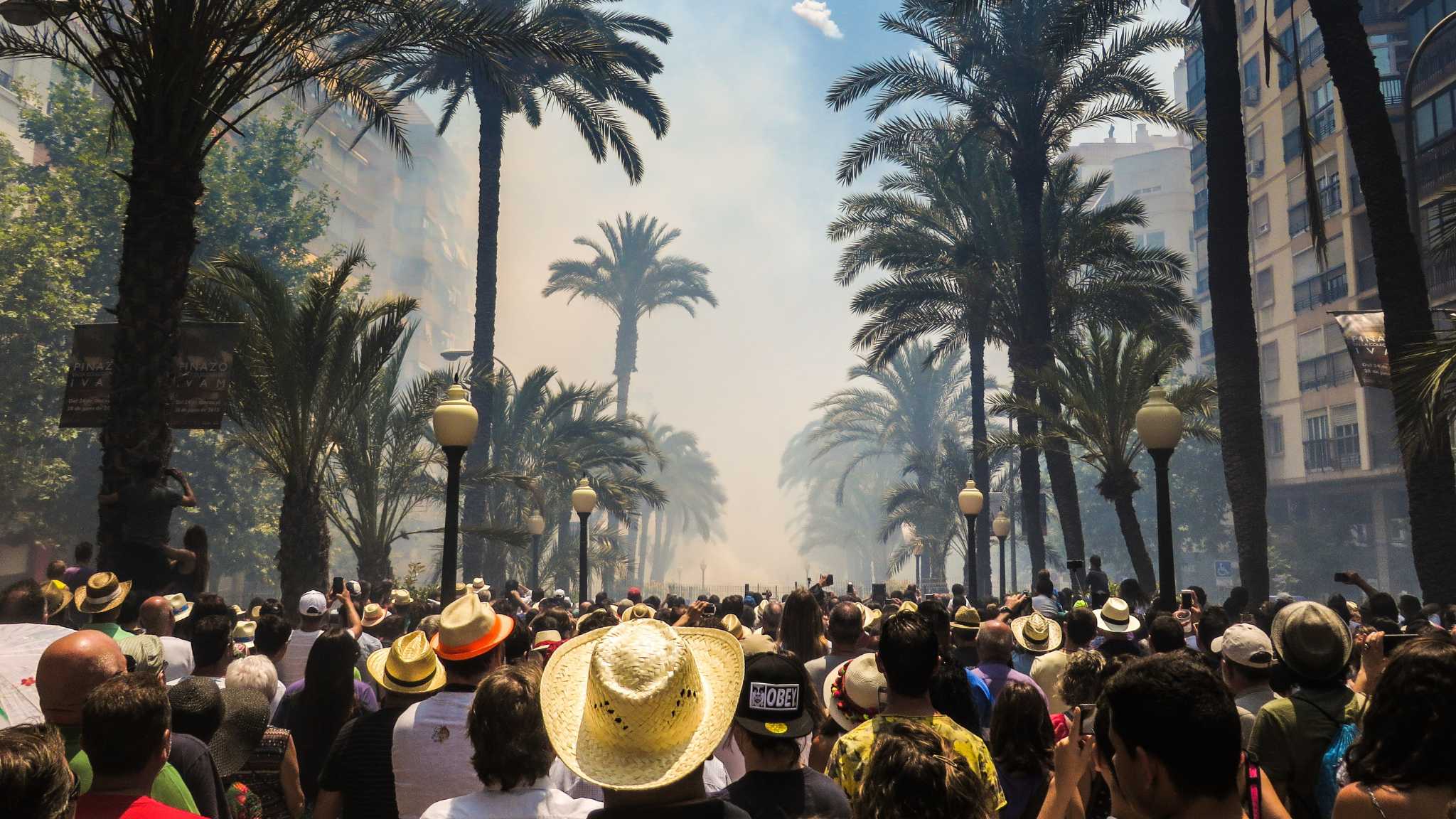
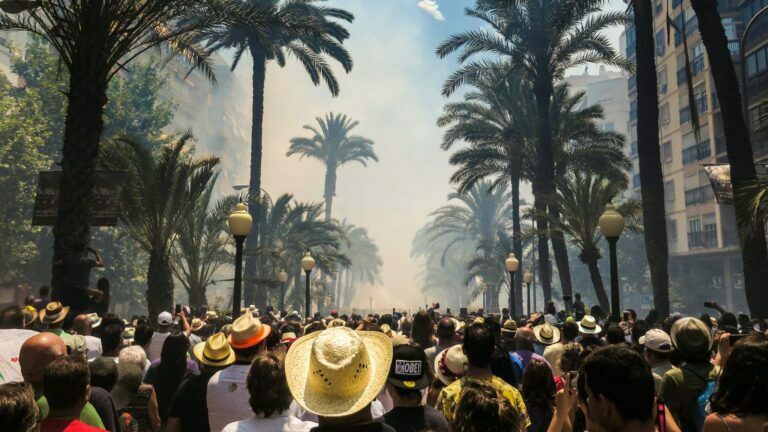
A “mascletá” is a unique and essential part of the Hogueras de San Juan. During this San Juan Festival in Spain it is a daytime fireworks display that focuses more on the sound than the visual effects.

Held daily at 2 PM in the Plaza de los Luceros, the mascletá is a thunderous and rhythmic explosion of firecrackers that creates a symphony of noise and vibrations.
It’s a thrilling experience that showcases the pyrotechnic expertise of the local teams of this Alicante festival.
👉Note: The sound of the mascletá is very loud, so loud that you feel it in your whole body. It is something very exciting but perhaps not for everyone. Do not bring your dog with you, they have a hard time.
When Are the Bonfires Placed in the Street?
The bonfires are placed in the streets on June an event known as “La Plantà.”
This marks the beginning of the festival, and the streets of Alicante are transformed into open-air art galleries. Each neighborhood has its own hoguera, and the competition to create the most impressive and elaborate bonfire is fierce.
Artists and sculptors work tirelessly for months to prepare these creations, which are often satirical and reflect current events or social issues.

What Is a Barrack?
A “barrack” or “barraca” is a temporary structure set up by various neighborhoods during the Hogueras de San Juan Alicante 2025.
These barracks serve as social hubs where locals and visitors gather to eat, drink, and dance. Each barrack is decorated in a unique style, often reflecting the theme of the neighborhood’s hoguera.
They offer a variety of traditional foods and drinks, and provide a space for the community to come together and celebrate.

What’s a Ninot?
A “ninot” is a small, individual figure that is part of a larger hoguera. These figures are intricately crafted and often depict famous personalities, politicians, or satirical scenes.
Before the bonfires are burned, an exhibition is held where visitors can view and vote for their favorite ninot. The most popular ninot, known as the “Ninot Indultat,” is spared from the flames and preserved in the Museo de Hogueras.
This tradition adds an element of suspense and excitement, as artists and neighborhoods vie for the honor of having their ninot saved from destruction.

Contests and Awards
The Hogueras de San Juan is not just a celebration; it’s also a competition. Various contests and awards are held to recognize the best hogueras, ninots, and parades.
The most prestigious award is for the best hoguera, judged on creativity, craftsmanship, and overall impact. There are different categories based on the size and budget of the hogueras, ensuring that both large and small creations have a chance to be recognized.
Other awards are given for the best ninot, the best barrack, and the best musical performance in the parades.
Traditional Dress
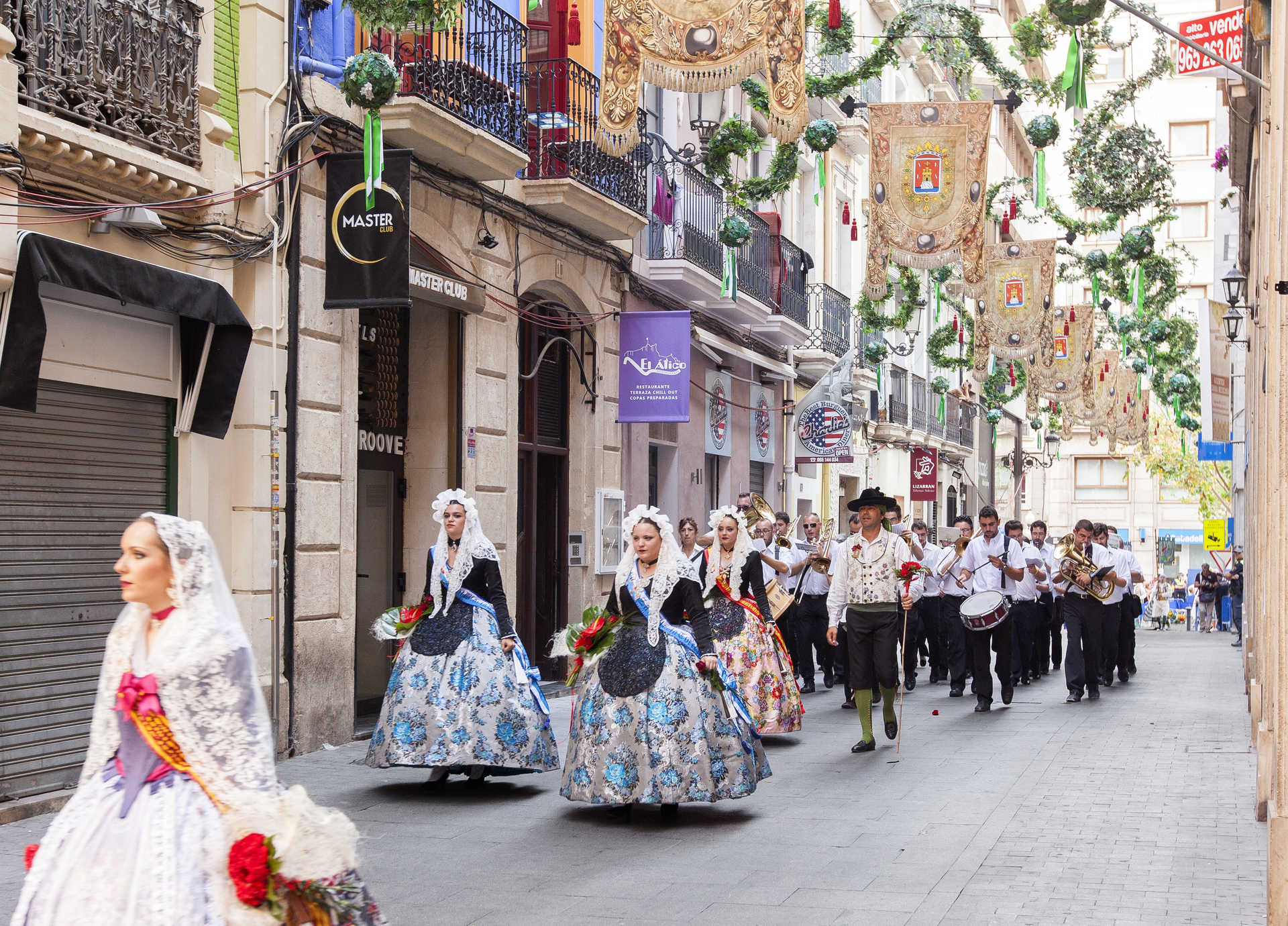
The men’s attire typically includes a white shirt, black trousers, and a colorful sash, while the women’s dress is more elaborate, featuring a long skirt, apron, blouse, and a lace mantilla.
These costumes are often adorned with intricate embroidery and complement the traditional hairstyles and jewelry. These costumes are called “alicantino” and “alicantina” costumes.

Origin and Meaning
The origins of the Hogueras de San Juan can be traced back to ancient pagan rituals celebrating the summer solstice.
These celebrations were later incorporated into Christian traditions, specifically honoring Saint John the Baptist, whose feast day falls on June 24. Over time, the festival evolved into the elaborate spectacle it is today, blending religious reverence with cultural expression.
The burning of the bonfires symbolizes the purification of the soul and the casting away of negativity and impurities. It’s a time of renewal and new beginnings, as the flames light up the night sky, illuminating the darkness and heralding the arrival of summer.
Originally an agricultural festival where dry harvest waste was burned, the first documented reference dates back to 1822, when lighting bonfires was prohibited. Despite the bans, the tradition persisted, becoming “festes de carrer” in 1881.
In 1928, the Alicante Atracción association, with José María Py, proposed making the bonfires official to attract tourism, similar to the Fallas of Valencia. That year, the first official bonfires were a success, attracting over one hundred thousand people. Although there were criticisms from Valencia, the celebration grew, including elements such as the Barraca and the election of the Bellesa del Foc from 1932.
Today, with nearly ninety Commissions of Foguera and over ten thousand participants, Les Fogueres de Sant Joan are the Official Festivals of Alicante, declared of National and International Tourist Interest, and in 2014, they were recognized as an Intangible Cultural Heritage by the Valencian Government.
Are the bonfires the same as the Fallas? Yes and no.
The celebration is similar and based on the same concept. Sculptures are made, there are mascletàs, barracas, etc.
But in Alicante, they happen in the summer, while in Valencia, they occur when spring arrives. This changes everything because it allows for firefighters to spray people with water during the Cremà day in Alicante.
This is the craziest day in Alicante all year, and just for that reason alone, it’s worth experiencing.
FAQs about Hogueras de San Juan or Hogueras Alicante 2025
FAQ Accordion The Bonfires of San Juan are an annual festival in Alicante celebrating the arrival of summer, involving the creation and burning of large wooden and papier-mâché sculptures . Other people call them vuurwerk alicante
The festival runs from June 19 to June 24, with the bonfires being burned on the night of June 24.
A mascletá is a daytime fireworks display focused on creating a rhythmic series of loud explosions, held daily at 2 PM during the festival.
A barrack is a temporary structure set up by neighborhoods during the festival, serving as a social hub for eating, drinking, and dancing.
A ninot is a small figure that is part of a larger bonfire sculpture, often depicting satirical scenes or famous personalities. The best ninot is saved from burning and preserved in a museum.
Main events include the Plantà (placing the bonfires), daily mascletàs, parades, the judging of bonfires, and La Cremà (burning of the bonfires) on June 24.
Wear comfortable clothing and shoes, as you will be walking a lot. Consider bringing ear protection for the loud fireworks and mascletàs.
Yes, the festival is family-friendly, but parents should be mindful of the loud fireworks and large crowds, which might be overwhelming for young children.
The Cremà is the night when the bonfires are burned, taking place on June 24. It’s the culmination of the festival and is marked by spectacular flames and fireworks.
Yes and no. The celebration is similar with sculptures, mascletàs, and barracas. However, the Bonfires in Alicante are in summer, which allows for the unique tradition of firefighters spraying people with water on Cremà day.
Subscribe and don't miss anything!